

With Inputs from Tariq Mahmood Awan
Pakistan suffers from many crises, but one of them is rarely named. It is a crisis of definition. Every few years the demand for new provinces returns to our politics. Some want South Punjab. Some want Hazara. Some want to divide Sindh, and others want to divide Balochistan into smaller pieces for easier governance. Television debates are loud, but they rest on a confusion nobody stops to clear. Does Pakistan need new federal units, or new administrative units? The two are not the same. The answer decides whether we remain a federation in substance or only in name.
Begin with first principles. A state is organised either as a unitary state or as a federation. In a unitary state, sovereignty rests with the centre. The central government creates the subdivisions, defines their powers and may redraw or abolish them at will. China is the clearest example. It is a unitary state, and its provinces are administrative units. They exist because Beijing finds them useful. In large unitary states, the centre needs such units as a linchpin between the national government and local administration. They are instruments of convenience, not partners in sovereignty. In a unitary state, the centre draws and redraws the map.
A federation works the other way round. Here the federal units are not creatures of the centre. They are the constituent pillars of the state. The federation exists because the units agreed to come together. In a true federation, therefore, it is the federal units that draw and redraw the state, not the federal government. The federal government is a trustee. It holds the powers the units have entrusted to it, and nothing more. It does not own the units. They, in a real sense, own it.
Apply this to Pakistan. The Constitution of 1973 declares in its very first article that Pakistan shall be a Federal Republic. That single word, federal, carries consequences. It means Pakistan cannot have administrative units in the sense that China has them. It can only have federal units. A province in Pakistan is not a district writ large. It is a partner in the federation, with its own assembly, its own government, its own share in the resources of the state and its own guaranteed place in the constitutional order. To speak of creating provinces in Pakistan as if they were mere administrative conveniences is to speak the language of a unitary state while living in a federation.
This is not a matter of words. It goes to the heart of who has the authority to create a new province. If provinces were administrative units, the federal government could carve them out by executive decision or a simple act of parliament. But they are federal units. So the question becomes: who creates a federal unit? The answer is clear. Not the federal government. A new federal unit can only be created by the federal units themselves, when there is a genuine cultural, linguistic or historical demand for it within an existing federal unit. The people of a region must want it. Their province must agree to it. The process must begin from below, not be imposed from above.
The Constitution recognises this logic. Article 239 governs constitutional amendments, and its fourth clause protects the provinces in a decisive way. A bill that would alter the limits of a province cannot be presented to the President for assent unless the provincial assembly of that province has passed it by a two-thirds majority. This is the federal principle written into law. The province is the gatekeeper of its own boundaries. No federal majority, however large, can redraw a province against the will of its assembly.
Some have suggested a shortcut. If a provincial assembly refuses, why not hold a referendum and let the people decide directly? It sounds democratic. It is not constitutional. The federal government cannot invoke a referendum to bypass the power of a provincial assembly under Article 239. The Constitution has vested this specific power in the provincial assembly, and a referendum called by the centre cannot override a power that the Constitution has deliberately placed elsewhere. To do so would be to use the language of popular will to destroy the federal structure itself. It would turn the provinces back into administrative units by stealth.
What, then, of administrative convenience? Large provinces such as Punjab do face genuine problems of governance. Distances are vast. Services are uneven. Remote districts feel neglected by distant capitals. These problems are real, and they deserve real solutions. But the solution lies with the provinces. If administrative units are needed, the federal units themselves will establish them, through divisions, districts and empowered local governments. That is their right and their responsibility. Federations normally do not have administrative units at the federal level at all. The centre has no business creating them.
Why does this distinction matter so much? Because confusion about it has damaged Pakistan before. Whenever the centre has treated the provinces as administrative units, whether through One Unit, martial law or the centralisation of resources, the result has been alienation, resentment and, in 1971, catastrophe. The federation survives only when the provinces believe it is theirs. The moment they feel they are subordinates rather than partners, the bond weakens.
Pakistan must therefore settle its definition crisis. It must decide, once and for all, that it is a federation in spirit as well as in name. New provinces may well be needed. Cultural and historical demands deserve respect. But they must be created as federal units, by the will of the federal units, through the constitutional path of Article 239. Anything else is a unitary mindset wearing federal clothing.
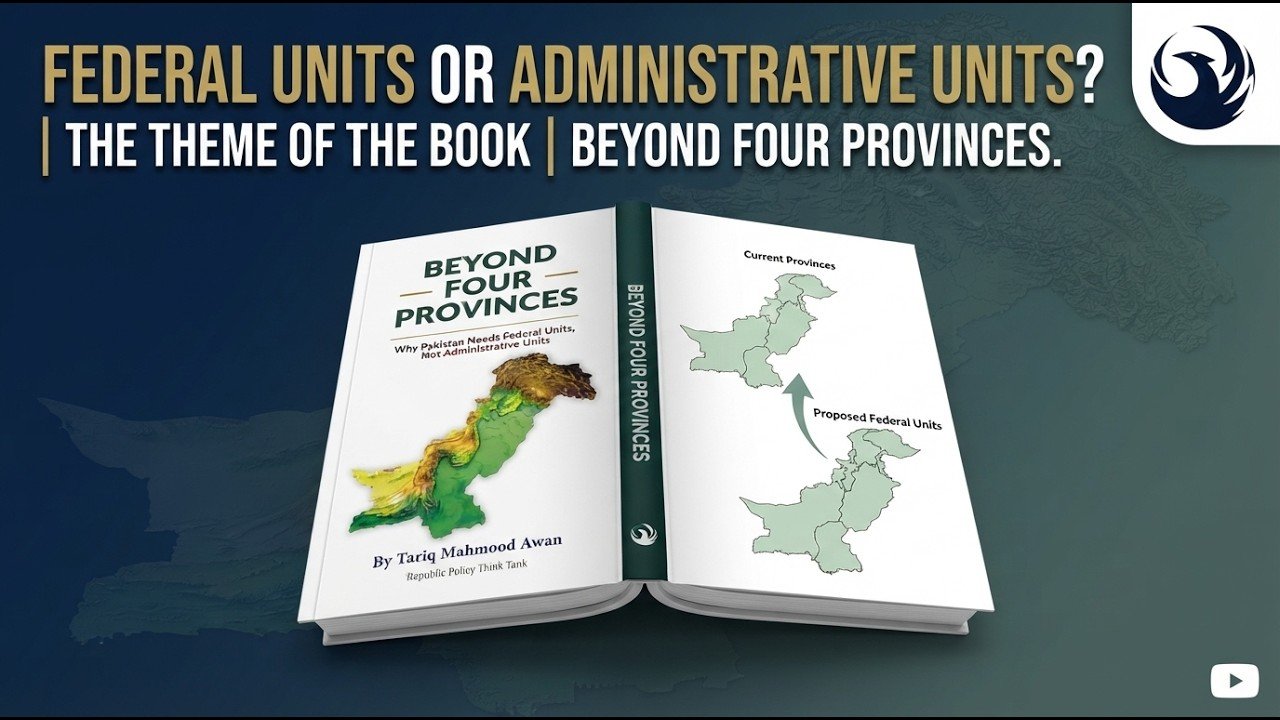
This is the fundamental distinction I have argued in my book, Beyond Four Provinces. The future of Pakistan’s federation depends on getting it right.
The best-selling books of Republic Policy Think Tank, including the landmark book The Bureaucratic Coup, are available at Vanguard Books, Liberty Books, Readings, Kitab Sarai, Sang-e-Meel, Saeed Book Bank Islamabad, National Book Foundation, and others across Pakistan. Contact for home delivery: +92 341 4222501.