
Five Pakistani cities have been ranked among the world’s 10 least resilient major cities to climate risks, highlighting the country’s growing vulnerability to climate change.
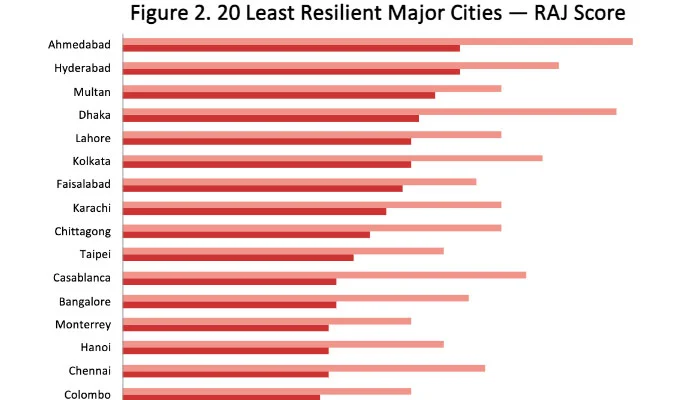
According to a new assessment by geospatial analytics company AlphaGeo, Hyderabad, Multan, Lahore, Faisalabad and Karachi are among the lowest-ranked cities for climate resilience. The study assessed 72 major cities worldwide by comparing their physical exposure to climate hazards with their capacity to adapt.
Hyderabad was ranked the second least resilient city, followed by Multan in third place. Lahore ranked fifth, Faisalabad seventh and Karachi eighth. India’s Ahmedabad topped the list.
The report found that the six major cities facing the highest resilience-adjusted climate risks are all located in South Asia: Ahmedabad, Hyderabad, Multan, Dhaka, Kolkata and Lahore. Heat exposure was identified as a major factor behind their vulnerability, while adaptation efforts remain insufficient compared with the scale of physical risks.
Ahmedabad and Hyderabad recorded resilience-adjusted risk scores of 41, followed by Multan at 38, Dhaka at 36, and Kolkata and Lahore at 35 each.
Dhaka emerged as the most physically exposed city in the assessment, with a physical risk score of 60. Although the Bangladeshi capital has made notable adaptation efforts, its remaining climate risk continues to be among the highest for major cities.
The report warned that high climate-risk scores could have serious consequences for property values, infrastructure durability and economic activity. Countries whose major cities remain highly exposed without sufficient adaptation could also face increasing costs from disaster response, infrastructure reconstruction and population displacement.
Pakistan and Bangladesh were identified as countries requiring particular attention because of the combination of high urban climate risks and limited capacity to strengthen adaptation at the pace required by growing physical threats.