
OP-Ed / Tariq Mahmood Awan
Pakistan’s governance debate must begin with a constitutional distinction: federal units constitute the federation, while administrative units organise the exercise of authority within it. Confusing the two risks reducing federalism to a question of administrative convenience.
The debate over creating new provinces in Pakistan is often framed as a question of administrative efficiency: whether smaller units would improve governance, bring government closer to citizens and make public services more accessible. These are important considerations, but they do not address the more fundamental constitutional question: What kind of political and constitutional structure should define the Pakistani federation?
Federal Units or Administrative Units? Rethinking the Foundations of Pakistan’s Federal Structure
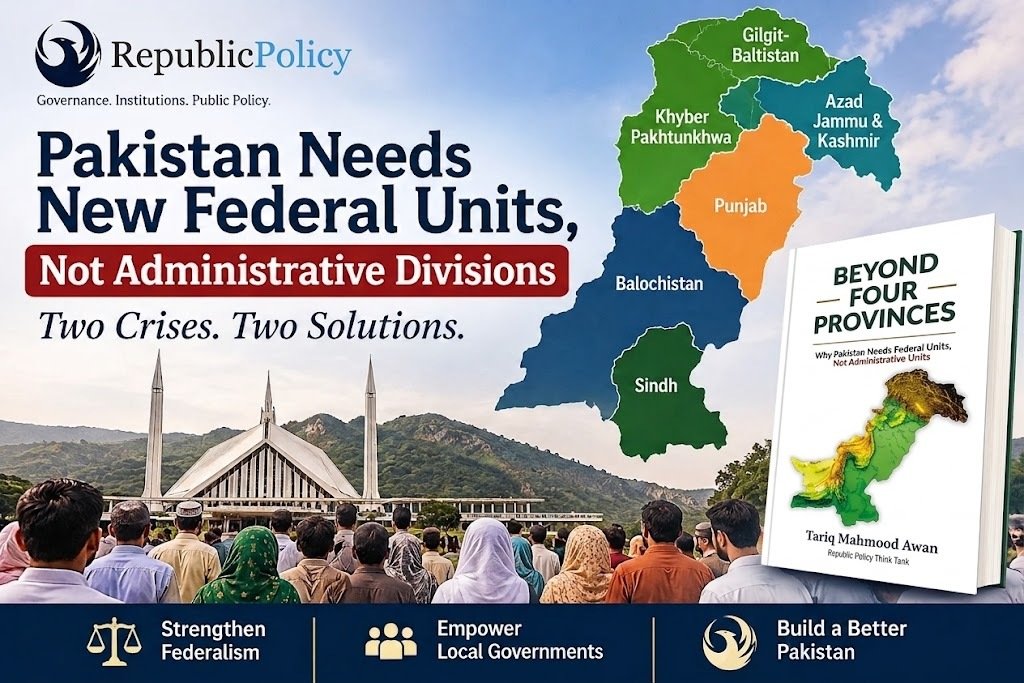
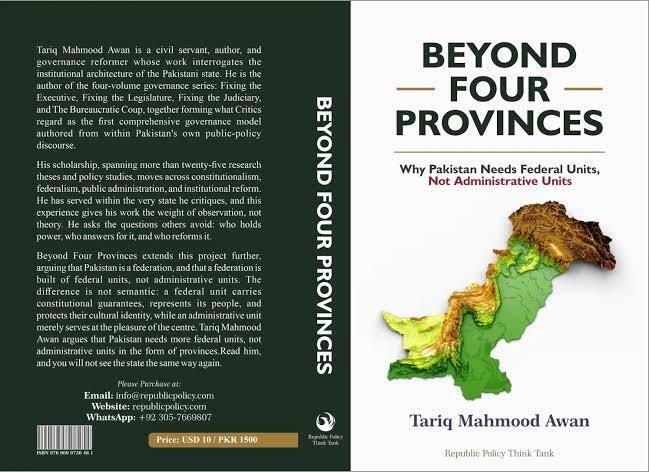
In Beyond Four Provinces: Why Pakistan Needs Federal Units, Not Administrative Units, I argue that Pakistan’s governance model must be understood through the state’s constitutional foundations and the political principles underpinning its formation. Article 1 of the Constitution identifies Pakistan as a federal republic. This constitutional identity brings two essential ideas into focus: federalism and republicanism. Together, they provide the framework for understanding the relationship between the federation, its constituent units and the citizens it serves.
The distinction between federal units and administrative units is therefore not merely terminological. It concerns the distribution of constitutional authority, the organisation of political power and the institutional foundations of democratic governance.
Federalism Is More Than Administrative Division
Pakistan is a federal state. Its constitutional structure must consequently be understood in terms of constituent federal units, rather than simply through the administrative division of territory.
Federal units and administrative units perform fundamentally different functions. Federal units are constituent components of the federation. Their status, authority and relationship with the central government are defined through the constitutional order. They possess constitutionally recognised political and administrative responsibilities and participate in the structure through which the federation is constituted.
Administrative units, by contrast, are established within federal or provincial units to facilitate the exercise of government. Their purpose is primarily administrative: to improve service delivery, bring public institutions closer to citizens, distribute administrative responsibilities and make governance more effective.
This distinction matters because administrative restructuring cannot, by itself, resolve questions of federalism. Creating additional administrative divisions, districts or other subordinate units may improve the organisation of government, but it does not necessarily alter the constitutional distribution of power between the federation and its constituent units.
A state cannot strengthen federalism merely by multiplying administrative boundaries. Federalism requires a meaningful constitutional arrangement in which constituent units possess defined authority and an institutional role within the federation.
Devolution and Federalism: Two Different Constitutional Questions
The distinction becomes clearer when federalism is considered alongside devolution.
Devolution concerns the transfer of authority, responsibilities and resources to lower levels of government. The creation of administrative units and the establishment of effective local governments belong to this broader framework. Their purpose is to bring decision-making closer to communities and improve the responsiveness of public institutions.
Federalism addresses a different question: how is the state constitutionally constituted, and how is authority distributed between the federation and its constituent units?
These two principles are complementary, not interchangeable. A federal system requires an effective structure of constituent units, while democratic governance requires authority to be exercised at the lowest appropriate level. Strong provinces or federal units do not automatically guarantee effective local government; equally, the creation of local governments cannot substitute for a coherent federal structure.
Pakistan’s governance debate must therefore avoid treating provincial restructuring and local government reform as competing alternatives. Both are necessary, but they serve different constitutional and administrative purposes.
The Case for a Coherent Institutional Architecture
The central argument of Beyond Four Provinces is that Pakistan needs a coherent constitutional, political and administrative framework that defines the relationship between federal units and the administrative units operating within them.
Such a framework must address three interconnected questions.
First, what should be the constitutional and political status of the federation’s constituent units? Federalism cannot function effectively when the relationship between the centre and its constituent units is understood primarily through administrative arrangements.
Second, how should administrative authority and responsibilities be organised within each federal unit? Administrative structures must be designed to facilitate governance, improve institutional coordination and ensure that public authority is exercised effectively.
Third, how should power be devolved to local governments? Democratic governance requires more than the existence of elected institutions at the national and provincial levels. Citizens must also have meaningful access to decision-making, public resources and accountable institutions closer to their communities.
These questions must be addressed together. Federalism without meaningful devolution risks concentrating power within provincial capitals. Devolution without a sound federal structure risks leaving the constitutional foundations of the state unresolved. Administrative restructuring without either may simply reproduce existing patterns of centralisation at a different territorial scale.
Beyond the Debate Over Four Provinces
Pakistan’s constitutional future should not be reduced to a binary choice between retaining the existing provincial structure and creating more administrative units. The more important task is to establish the constitutional principles that should guide any restructuring.
The number of units is not, by itself, a measure of federal strength or governance quality. What matters is their constitutional character, the authority they exercise, the resources available to them and the accountability mechanisms governing their institutions.
The objective should be a federation in which constituent units have a meaningful constitutional position, administrative institutions are organised for effective government, and local governments possess the authority and resources necessary to serve citizens.
This requires a shift in the way Pakistan approaches territorial governance. Instead of viewing the state primarily through the convenience of administrative boundaries, policymakers must begin with its constitutional identity as a federal republic. Institutional design should follow that principle, not substitute for it.
Reconstructing the Federal Republic
The future of Pakistan’s governance depends on getting this distinction right. Federal units constitute the federation; administrative units facilitate the delivery and exercise of government within it. Devolution brings authority closer to citizens, while federalism establishes the constitutional relationship between the constituent parts of the state.
These are distinct but mutually reinforcing dimensions of democratic governance. Treating them as interchangeable weakens the debate and risks producing reforms that change administrative boundaries without addressing the underlying distribution of constitutional power.
The argument advanced in Beyond Four Provinces is ultimately about more than creating additional units. It is about designing a federal republic in which constitutional authority, political representation, administrative responsibility and public accountability are properly aligned.
Pakistan does not need to confuse administrative expansion with federal reform. It needs a constitutional vision that recognises the difference between the units that constitute the federation and the institutions that administer it. That distinction should be the starting point of any serious debate about the country’s territorial and governance structure.
Republic Policy | Federalism. Constitutional Design. Governance.
Further Reading: Beyond Four Provinces: Why Pakistan Needs Federal Units, Not Administrative Units
Available at Vanguard Books and through Republic Policy Think Tank.
Book enquiries: +92 341 4222501