
Tariq Mahmood Awan
The basic reason is that bureaucracy has influence and influence over the entire decision-making system. Whenever the bureaucracy takes a file to the cabinet, it usually convinces the Prime Minister or Chief Minister easily and the file is approved. In this way, the proposed policy of the bureaucracy becomes a government policy. One of the major reasons for this is that the cabinet, including the Prime Minister or Chief Minister, neither has read the file in detail nor does it have a complete record of the related matters. As a result, they are forced to rely on the information and stance provided by the bureaucracy.
If the cabinet gives a dissenting note on a matter, the bureaucracy tries to push its stance forward through judicial proceedings. When matters go to courts, the bureaucracy also uses legal and administrative means to protect its institutional interests.
The matter of legislation is no different. The bureaucracy tries to get its way by convincing the Prime Minister, the Chief Minister, or the cabinet. As a result, the legislature is left with a free and effective role in legislation. Often, a prepared draft law is presented before the parliament or provincial assembly and is almost in the same form as what the bureaucracy has prepared. If any obstacle arises, the bureaucracy tries to protect its institutional interests by appealing to the judicial forums.
And if politicians or the judiciary do not agree with its stance, the bureaucracy uses its institutional interests to influence the relationships and influence with other powerful institutions of the state.
Thus, the bureaucracy continues to use its institutional interests to influence the relationships between politicians, the judiciary, and the establishment. Sometimes it influences one institution through another, and sometimes it uses another institution for its own purposes. In this entire process, the three major players, i.e., politicians, the establishment, and the judiciary, are involved in different matters, while the bureaucracy continues to benefit from their mutual relations to advance its institutional interests.
This is why in the past several decades, neither any elected political government has consistently challenged the bureaucratic establishment’s dominance, nor have military governments been able to fundamentally change this structure, nor has the judiciary succeeded in ending this administrative dominance. Whenever one party has tried to challenge this system, the bureaucracy has tried to find a way out for itself through another party.
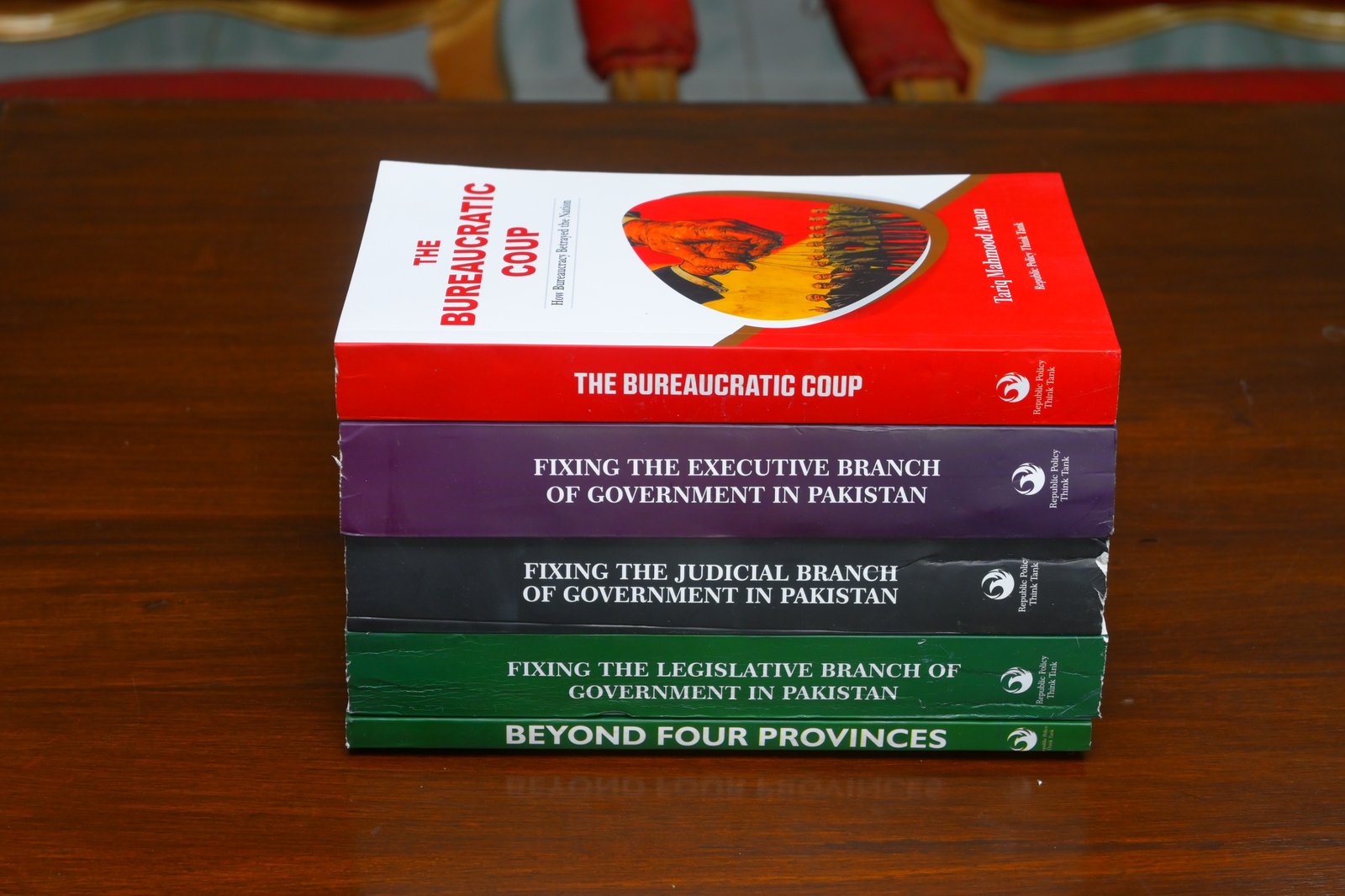
I have elaborated on this basic concept in my book The Bureaucratic Coup.
The book clarifies that the real problem in Pakistan is not merely the administrative power of the bureaucracy, but its institutional dominance over state decision-making. The book analyzes how the bureaucracy has brought the establishment, politicians, and judiciary into a confrontation with each other or has benefited from their mutual relations to further its own interests and maintain its dominance over the state system.
The Bureaucratic Coup
Available at:
– Republic Policy Think Tank
Contact: +92 341 4222501