
The leaders of the United States, China and Russia held their first-ever trilateral talks in Shenzhen, discussing nuclear risks, international security and global conflicts, but the meeting produced no concrete agreement on major disputes.
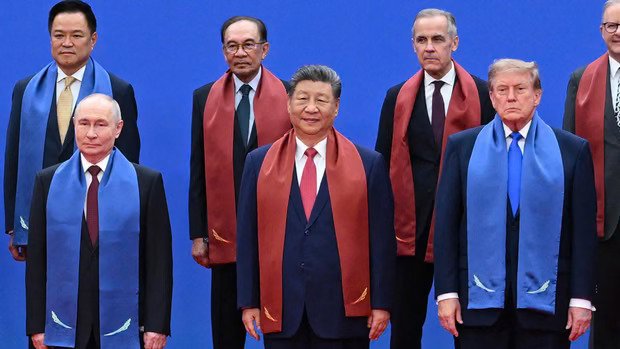
SHENZHEN: US President Donald Trump, Chinese President Xi Jinping and Russian President Vladimir Putin held an unprecedented three-way meeting on Thursday on the sidelines of the Asia-Pacific Economic Cooperation (APEC) summit, issuing a peace declaration that pledged dialogue on nuclear risks and international security but offered no clear breakthrough on major global conflicts.
The meeting brought together the leaders of the world’s three major nuclear powers in a rare diplomatic engagement, with discussions centred on nuclear weapons, international peace, energy security and their shared responsibilities in managing global affairs.
Trump described the gathering as historic, saying the three countries were uniquely positioned to discuss reducing nuclear stockpiles and addressing some of the most consequential challenges facing the international community.
The US president said the three leaders were “really making history”, signalling his interest in using direct engagement between Washington, Moscow and Beijing to address international tensions.
Putin also highlighted areas of common interest among the three countries, arguing that they shared responsibilities for maintaining international peace and security. He referred to the possibility of cooperation in resolving conflicts, including the war in Ukraine, which continues to remain one of the most significant geopolitical disputes confronting the international community.
Xi, meanwhile, stressed the importance of preventing nuclear conflict, calling for every effort to eliminate the threat posed by nuclear weapons. He reiterated the position that nuclear weapons should ultimately be prohibited and destroyed, highlighting the catastrophic consequences of a nuclear confrontation.
A declaration without a major breakthrough
Following the meeting, the three countries issued a four-point peace declaration outlining their commitments to international security and cooperation.
The declaration emphasised the need to reform the United Nations to enable it to respond more effectively to global challenges and fulfil its responsibility to maintain international peace and security.
The three leaders also discussed energy security, expressing their intention to increase the production and supply of refined petroleum products and maintain stable energy flows for the benefit of countries around the world.
Another component of the declaration concerned international legal institutions. The leaders stressed the importance of state consent and the immunity of state officials, while calling on the International Criminal Court and similar institutions not to abuse their jurisdiction.
The most consequential element of the statement, however, concerned nuclear weapons. The three countries reaffirmed that nuclear war cannot be won and must never be fought, while agreeing to engage in dialogue aimed at reducing nuclear risks and preventing proliferation.
Despite the language of cooperation, the declaration did not establish a concrete framework for nuclear disarmament, specify a timetable for negotiations or resolve the disagreements that have historically complicated relations among the three powers.
Ukraine remains a major dividing line
The war in Ukraine remains one of the most difficult issues separating Washington and Moscow, despite Trump’s efforts to pursue direct engagement with Putin.
Putin said the three countries had converging interests in addressing international conflicts and maintaining global stability. However, the meeting did not produce a clearly defined agreement on the future of the war or a framework for ending hostilities.
The absence of a substantive breakthrough underlines the limitations of high-level diplomacy when the interests of major powers remain fundamentally different.
While direct engagement may help reduce tensions and open channels of communication, it does not necessarily translate into agreement on territorial disputes, security arrangements or the terms of peace.
Ukraine’s future also raises concerns about the role of smaller and middle-sized states in negotiations involving the world’s most powerful countries. Any diplomatic arrangement concerning Ukraine without meaningful participation by Kyiv would raise questions about sovereignty and the legitimacy of decisions imposed through great-power negotiations.
Nuclear diplomacy returns to the centre
The summit’s nuclear dimension is particularly significant as global arms-control arrangements face uncertainty and strategic competition among major powers continues to intensify.
The United States and Russia possess the world’s largest nuclear arsenals, while China is expanding its nuclear capabilities. The three countries’ agreement to pursue dialogue on nuclear risks therefore carries considerable international importance.
Xi’s emphasis on preventing nuclear war and Trump’s willingness to discuss reductions in nuclear stockpiles suggest that nuclear diplomacy remains an area where the three powers may find some common ground.
However, declarations of intent are different from binding commitments. Nuclear arms control requires sustained negotiations, verification mechanisms, transparency and a willingness to accept limitations on military capabilities. None of these arrangements emerged as a concrete outcome of the Shenzhen meeting.
The declaration may therefore represent an opening for future dialogue rather than a significant change in the strategic relationship among the three countries.
The International Criminal Court controversy
Trump also criticised the International Criminal Court, describing it as “out of control”, while Putin remains subject to an arrest warrant issued by the court in 2023 over alleged war crimes related to Ukraine.
The issue reflects the continuing disagreement between powerful states and international legal institutions over jurisdiction, sovereignty and accountability.
The declaration’s language on state consent and the immunity of officials is likely to attract attention in this context, particularly as international institutions face growing political pressure from states that question their authority or legitimacy.
A historic meeting, but what comes next?
The unprecedented gathering itself carries symbolic importance. Direct communication among the leaders of the three largest nuclear powers could help reduce the risks of miscalculation, improve diplomatic engagement and create opportunities for cooperation on issues where their interests overlap.
Yet the global political environment remains deeply divided. Conflicts, strategic competition, economic rivalries and disputes over international institutions continue to shape relations among major powers.
The Shenzhen meeting demonstrated that Washington, Beijing and Moscow are willing to sit together and discuss their responsibilities in maintaining international security. But the peace declaration remains a statement of principles rather than a settlement of the world’s major conflicts.
The real test of this historic summit will be whether the three leaders translate their commitments into sustained diplomatic engagement, meaningful nuclear-risk reduction and progress on the conflicts that continue to threaten international peace.
For now, the meeting has opened a channel for dialogue—but it has not fundamentally changed the geopolitical landscape.