
Republic Policy | Governance. Institutions. Public Policy.
The country has invested in producing electricity without building a sufficiently capable network to deliver it. The result is an expensive contradiction: surplus generation capacity, unmet demand and cheaper power that cannot reach consumers.
Pakistan’s electricity debate has long been dominated by a familiar question: how much more power does the country need to generate? Governments have responded by adding power plants, signing generation agreements and expanding installed capacity. Yet the country continues to experience high electricity costs, supply constraints and a persistent gap between the availability of power and its delivery to consumers.
This raises a more fundamental question: has Pakistan built an electricity system that can efficiently transport the power it is capable of producing?
The figures presented in the current debate point to a serious structural mismatch. Pakistan has an installed generation capacity of approximately 44,000 megawatts, while the maximum transmission capacity is estimated at around 26,000 megawatts. If these figures are comparable measures of usable system capacity, the gap is substantial. It suggests that investment in generation has not been matched by the development of the infrastructure required to transmit electricity across the country.
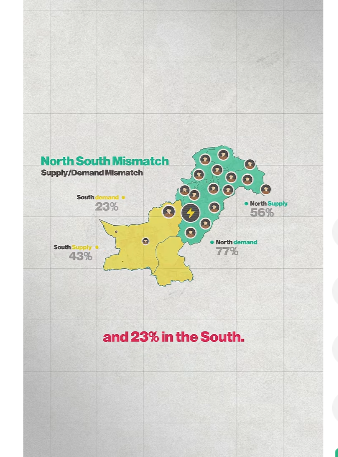
The geographical distribution of generation and consumption makes the problem even more striking. Approximately 56 per cent of generation capacity is located in the north and 43 per cent in the south. Electricity demand, however, is concentrated differently: around 77 per cent of consumption is in the north, compared with 23 per cent in the south.
This imbalance should have been central to national energy planning. A power system cannot be designed by considering generation capacity in isolation. It must account for where electricity is produced, where it is consumed, how much power the transmission network can carry and what it costs to move electricity between regions. Pakistan’s figures suggest that these considerations have not been adequately integrated.
The economic implications are particularly important. The marginal cost of generation in the south is cited at approximately Rs16 per unit, compared with Rs35 per unit in the north. This difference creates an obvious economic opportunity: transmit relatively cheaper electricity from southern generation centres to the northern regions where demand is concentrated.
Yet the transmission network cannot always accommodate the required flows. Consequently, the country may be unable to utilise cheaper generation to its full potential, even while consumers face high electricity costs. Investments in southern energy projects, including Thar coal-based and nuclear power plants, cannot deliver their full national benefit if the grid lacks the capacity to carry their output to major consumption centres.
This is not merely an engineering problem. It is a failure of economic planning. When a country invests in generation without making corresponding investments in transmission, it risks creating expensive assets that cannot be used efficiently. The cost of this mismatch eventually appears in electricity tariffs, capacity payments, constraints on industrial activity and the wider burden on households and businesses.
The Geography of Electricity and the Failure of Planning
The north–south imbalance also exposes a weakness in the way Pakistan approaches infrastructure development. Generation projects, transmission corridors and consumption patterns are often treated as separate planning questions. In reality, they are parts of one interconnected system.
A power plant has limited economic value if its electricity cannot reach the market. Similarly, a transmission line cannot be planned effectively without reliable projections of future demand, generation locations and the changing composition of the energy mix.
The expansion of Thar coal and nuclear generation in the south makes this coordination increasingly important. The country must ensure that transmission infrastructure develops alongside generation capacity, rather than years after investment decisions have already been made.
There is also a broader access question. Despite substantial installed generation capacity, significant sections of the population reportedly remain without electricity access. The estimate that 20–30 per cent of the population lacks access requires verification against current official access data, but the underlying policy contradiction deserves attention: national generation figures mean little to communities that have no connection to the electricity network.
Energy policy must therefore distinguish between three different objectives: producing electricity, transmitting it efficiently and ensuring that households and businesses can actually access it. Success in the first does not guarantee success in the other two.
An Ageing Grid Adds to the Cost
The problem is compounded by the condition of the existing transmission infrastructure. An electricity network must not only have sufficient capacity; it must also operate reliably and efficiently. Ageing equipment, technical constraints, congestion and inadequate investment can increase losses and prevent the system from using available generation effectively.
The cited estimate of approximately 2.5 per cent transmission losses points to another dimension of the problem. Every unit lost before reaching consumers represents electricity that has already incurred a generation cost but produces no corresponding benefit for the end user. Reducing these losses requires modern equipment, improved grid management, regular maintenance and investment in network efficiency.
Pakistan cannot continue treating transmission as a secondary component of energy policy. It is the infrastructure that connects generation investment with economic activity and public access.
A Different National Energy Strategy
The solution is not simply to build more power plants or to shift all investment towards one region. Pakistan needs an integrated national electricity strategy that places generation, transmission, distribution and access within a single planning framework.
First, transmission investment must be aligned with the geographical distribution of demand and future generation. The country needs stronger north–south transmission corridors and a credible assessment of the capacity required to transport electricity from lower-cost generation centres to major consumption markets.
Second, the government must prioritise the modernisation of existing infrastructure. Upgrading substations, transmission lines, grid-management systems and other critical equipment can improve the utilisation of existing assets and reduce technical losses.
Third, generation approvals should be linked to transmission readiness. New power plants should not be planned or contracted without a clear assessment of how their electricity will enter the national grid and reach consumers. The same principle should apply to major renewable energy investments, whose output and location must be incorporated into a coherent grid-development plan.
Fourth, Pakistan needs greater transparency in power-sector planning. NEPRA, NTDC and other relevant institutions should make publicly accessible the data on regional generation, demand, transmission constraints, curtailment, marginal generation costs and system losses. Without reliable and comparable information, neither policymakers nor citizens can properly assess the performance of the electricity system.
Finally, energy planning must be judged by the price, reliability and accessibility of electricity delivered to consumers, not merely by the number of megawatts added to the national capacity.
Pakistan’s electricity crisis reveals a deeper lesson about public policy: infrastructure is only as valuable as the system that connects its individual components. A country may possess power plants, fuel resources and technical expertise, but poor coordination can prevent these assets from serving the economy.
The central challenge is therefore not simply to generate more electricity. It is to build a national grid capable of delivering affordable power wherever it is needed. Until Pakistan corrects this fundamental mismatch, additional generation capacity alone will not resolve the contradictions of its power sector.
The measure of an effective electricity system is not how much power it can produce, but how efficiently and affordably that power reaches the people and businesses that need it.
Input from PakistanAndCounting