
Editorial
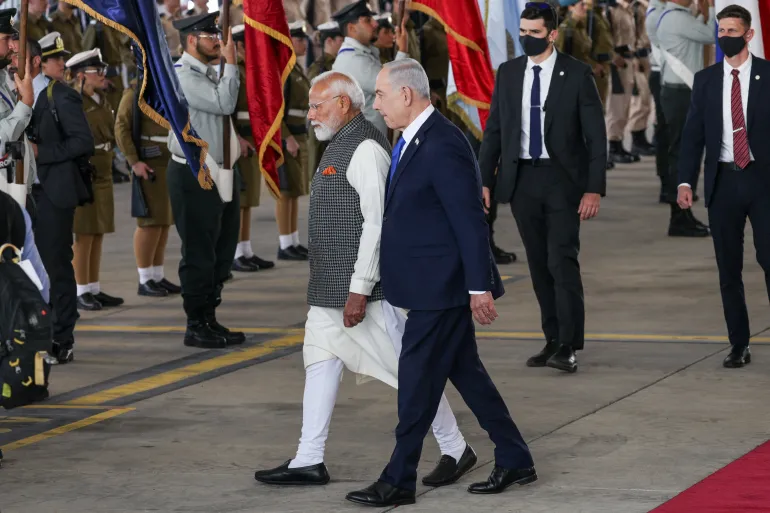
When Narendra Modi landed in Tel Aviv this week, the message was not diplomatic. It was strategic. He embraced a leader under an international arrest warrant, prosecuting a war the world is watching with horror, and he did so without hesitation. That embrace tells you everything about where India believes the future is heading.
Benjamin Netanyahu has been talking about a hexagon of alliances, a regional architecture placing India at its centre alongside Greece, Cyprus, and unnamed Arab and African partners. Its stated purpose is to counter what he calls radical axes, Shia and Sunni both. Given that Saudi Arabia and Pakistan formalized a mutual defence agreement in September 2025, and that Pakistan maintains close ties with Turkiye, reading between Netanyahu’s lines requires no particular intelligence training. Pakistan is in the frame.
The military dimension is already concrete. Indian firms supplied rockets and explosives to Israel during the Gaza war. Israeli drones were used against Pakistan during the four-day aerial conflict in May 2025. Intelligence sharing between RAW and Mossad goes back to the 1960s. What is being deepened this week, through discussions on Iron Beam technology, Iron Dome manufacturing transfers, AI and cybersecurity cooperation, is not a new relationship. It is an old one being elevated to a different order of magnitude.
Pakistan must think carefully about what this means. Its Gulf partnerships, its Saudi agreement, its alignment with Turkiye: these are real assets, but they require economic depth to hold their weight. Diplomatic goodwill without trade infrastructure is a fragile thing.
The India-Israel axis is not a threat Pakistan can wish away or dismiss as noise. It is a structural realignment taking shape in real time, and Islamabad’s response to it will define its strategic position for the next generation.