
By Dr Amir Raza
A harrowing tragedy teetered on the brink in KP’s Battagram area this past Tuesday, narrowly averted by a heroic rescue mission. Eight individuals, predominantly children, found themselves in a perilous predicament when the cables of their cable car snapped high above the ground.
While we extend our heartfelt praise to all those involved in this daring rescue, it is imperative to recognize that this incident serves as an alarming reminder of the pressing need for enhanced and more secure infrastructure in remote locales like Allai, where this heart-stopping episode unfolded. These areas necessitate improved facilities to ensure the safety and well-being of their residents.
The occupants of the cable car were on their way to school when catastrophe struck, leaving them suspended precariously hundreds of feet above a meandering river. This crisis triggered a formidable 14-hour-long collaboration involving military personnel, dedicated rescue workers, and steadfast locals, ultimately resulting in success.
Initial attempts to recover the stranded cable car passengers via helicopter proved to be of limited efficacy. However, the rescuers did not waver; they pressed on with their operation, even as night descended, concluding the spine-tingling ordeal by safely retrieving all the occupants. Their courage knew no bounds as they risked their own lives by descending along the remaining cables.
Such extraordinary feats are commonly witnessed on the silver screen, but these real-life heroes deserve nothing less than the nation’s utmost gratitude for their profound selflessness and unwavering bravery in the face of an exceedingly daunting situation. Their actions embody the very essence of heroism, reminding us that even in our most challenging moments, humanity prevails.
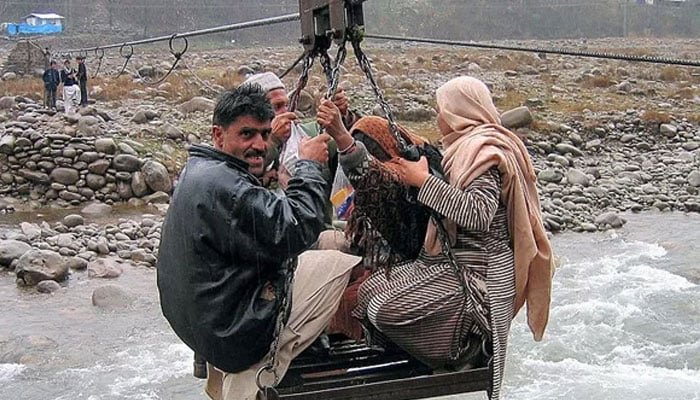
The recent heart-stopping incident should serve as a compelling impetus for the state to address the longstanding communication challenges faced by communities residing in remote, rugged terrains, much like Allai. In reality, due to the dearth of infrastructure, including roads and bridges, cable cars often represent the sole viable means of transportation in various mountainous regions, particularly in KP, Gilgit-Baltistan, and Azad Kashmir.
While it is undeniable that safety standards for these cable cars may leave ample room for improvement — many of them are constructed through grassroots efforts by locals — this mode of aerial conveyance is nothing short of a lifeline for the denizens of secluded valleys and hamlets.
Cable cars have the dual advantage of significantly reducing both travel time and expenses. What might ordinarily entail a lengthy and costly road journey, spanning hours and incurring substantial expenses, can be accomplished in a matter of minutes, and for a pittance. Nonetheless, the looming specter of accidents is an ever-present concern, as underscored by the harrowing events of Tuesday. In 2017, a strikingly similar incident occurred in Murree, resulting in several tragic fatalities.
To mitigate this pervasive risk, it becomes imperative to prioritize the development of critical infrastructure, including the construction of roads and bridges, to seamlessly connect settlements in remote locales. However, if these endeavors prove prohibitively costly, a viable alternative is the installation of professionally constructed cable car systems. To bolster these efforts, entities such as Rescue 1122 and PDMA, KP, should actively engage trained cable car rescuers in the hilly terrains of Battagram, Shangla, Kohistan, and Chitral, ensuring a rapid and efficient response in the event of emergencies.
Local administrations, on their part, bear the responsibility of conducting rigorous safety inspections of such structures on an ongoing basis. Furthermore, it falls upon the state to provide fundamental amenities, including schools and clinics, in close proximity to residential areas. This strategic placement aims to alleviate the burdens borne by individuals who would otherwise have to traverse vast distances and treacherous landscapes to access education or medical services. Moreover, the development of enhanced telecommunications infrastructure can significantly facilitate online learning and telemedicine services in these remote communities.
The Allai cable car incident serves as a stark reminder of the challenges faced by remote communities in rugged terrains. While cable cars provide a lifeline, safety remains a paramount concern. The state must prioritize infrastructure development and professional management to ensure the safety of these vital transport systems. Additionally, enhancing local access to education, healthcare, and telecommunications can reduce the reliance on risky aerial transportation. Vigilance, innovation, and swift response are essential to avert tragedies like this in the future.
Subscribe our website for latest updates:
https://republicpolicy.com/shop/
Read More