
Zafar Iqbal
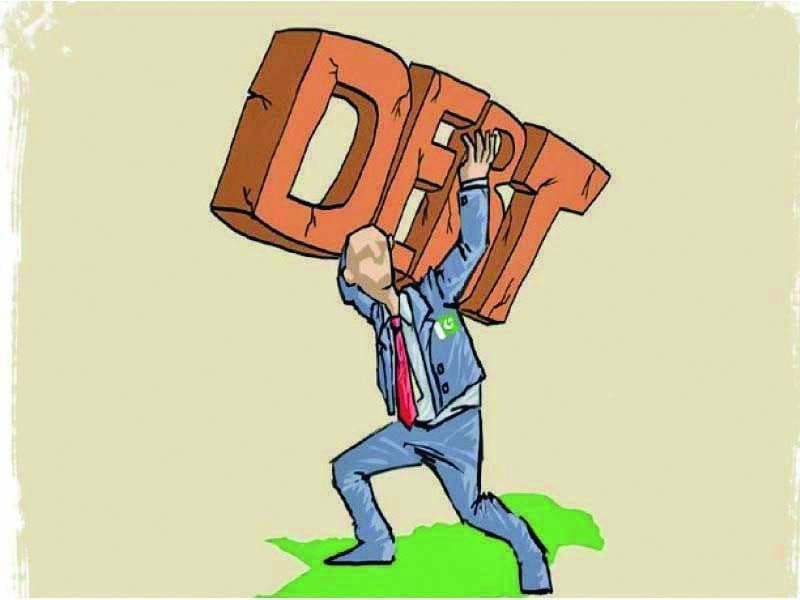
Pakistan’s federal government debt touched Rs81.9 trillion by the end of May 2026. The figure itself commands attention, but the number is not really the story. The story is the system that keeps generating this debt and then quietly absorbing it, cycle after cycle, without ever resolving the underlying weakness. The state borrows heavily from domestic banks. Banks, in turn, build comfortable and profitable balance sheets around government paper. The central bank is left holding the operational burden, managing liquidity in a market that has increasingly organized itself around the government’s financing appetite rather than the economy’s credit needs.
Central government debt climbed from Rs77.9 trillion in June 2025 to Rs81.9 trillion by May 2026, an increase of Rs4.1 trillion inside eleven months. Domestic debt did most of the heavy lifting, rising from Rs54.5 trillion to Rs58.1 trillion, while external debt in rupee terms moved more modestly, from Rs23.4 trillion to Rs23.8 trillion. On the surface, this looks like a domestically financed expansion, and domestic financing is usually presented as the safer route. That comfort is misplaced here. The real issue is not where the debt sits, but how concentrated it has become within one part of the financial system.
Domestic borrowing does reduce foreign-exchange exposure, true enough, but it does not eliminate risk. It relocates that risk into the domestic banking system. A government that leans on domestic banks may face less immediate pressure from external creditors, but it deepens something else entirely: fiscal dominance over the local financial sector. Bank balance sheets grow more exposed to sovereign paper. The government securities market becomes the centre of gravity for liquidity management. Private credit, instead of being the core purpose of a banking system, becomes an afterthought, a residual activity squeezed in around the edges of sovereign financing.
The International Monetary Fund has repeatedly pointed to this same pattern, describing it as a sovereign-bank-central bank nexus. Pakistan does not need an outside institution to explain a loop that is visible from the inside. The government has large financing needs. Banks absorb a heavy share of government securities because that paper is liquid, easy to scale, comfortable from a regulatory standpoint, and commercially rewarding. The central bank is then left to manage the liquidity, the collateral arrangements, and the monetary policy fallout of a system where government debt has become the dominant financial asset in the country.
The familiar crowding-out argument, that heavy government borrowing squeezes out private credit, only captures part of the picture. The deeper problem is structural. Sovereign exposure has become the organizing principle around which the entire financial system runs. Government securities are the easiest source of bank income, the preferred form of liquid asset, the main instrument used as collateral, and the reference point for money-market activity. The state, rather than the productive economy, has become the axis around which banking decisions revolve.
The maturity structure of this debt adds further strain. Short-term domestic debt rose from Rs8.8 trillion in June 2025 to Rs10.7 trillion by May 2026, with Market Treasury Bills alone climbing from Rs8.6 trillion to Rs10.6 trillion. This raises the frequency with which debt must be rolled over and leaves the government exposed to both refinancing risk and interest-rate risk. The more troubling consequence is behavioural. When a government repeatedly leans on short-tenor domestic paper, continuous refinancing stops being an occasional tool and becomes the default mode of fiscal management. The deficit itself is never actually resolved. It is simply re-priced and pushed forward, again and again.
This produces a tight, self-reinforcing loop. The deficit persists. The government borrows to cover it. Banks absorb the resulting paper. The central bank manages whatever liquidity consequences follow. No single actor in this chain is behaving irrationally. The finance ministry must fund the deficit. Banks prefer high-yield sovereign exposure that requires little underwriting effort. The central bank must keep the system functioning smoothly. Yet the combined outcome is a financial system that has become far more skilled at financing the state than at financing the economy it is supposed to serve.
Within this picture, Pakistan Investment Bonds actually declined slightly, from Rs35.0 trillion to Rs34.6 trillion, while GOP Ijara Sukuk rose from Rs5.2 trillion to Rs7.5 trillion. A more developed Islamic debt market is a welcome development in its own right and can support genuine investor diversification. But switching instruments is not the same thing as fiscal strengthening. The underlying dependence has not moved an inch. The state continues to absorb a disproportionate share of the country’s domestic financial savings, regardless of which instrument carries that absorption.
The external debt picture looks deceptively calm in rupee terms, largely because the exchange rate held steady across the period in question. Beneath that calm surface, short-term external debt jumped sharply, from Rs210 billion to Rs2.7 trillion, even as long-term external debt declined. A shift of that magnitude deserves scrutiny before anyone treats it as a straightforward story of external risk. It could reflect timing effects, classification changes, or rollover treatment rather than a genuine deterioration. Either way, the headline external debt figure is far too quiet a number to carry the full weight of the risk story.
This nexus matters because bank profitability built around sovereign paper can create a misleading picture of financial-sector health. Banks may look liquid, profitable, and well-capitalized on paper, while a meaningful share of that strength depends on treating sovereign exposure as essentially risk-free. That assumption removes the pressure on banks to build real private-credit capability. It weakens incentives to invest in sectoral underwriting expertise and encourages balance sheets to expand around government paper instead of the productive economy. Banks do not favour sovereign debt merely out of convenience. They favour it because the alternatives are genuinely harder. SME lending demands documentation, recovery mechanisms, collateral enforcement, sector expertise, and credit history. Agricultural lending demands cash-flow-based appraisal and detailed field knowledge. Export financing demands an understanding of working capital and performance risk. Sovereign paper, by comparison, demands nothing more than watching the auction calendar.
Pakistan’s way out of this loop cannot rely on the usual policy checklist alone. Longer debt maturities, a wider tax base, expenditure discipline, reform of public-sector enterprises, and better coordination between federal and provincial finances all matter. But the financial sector’s exit from this trap requires something more deliberate: building genuine non-bank demand for government paper through pension funds, insurance companies, and mutual funds, while gradually freeing banks to originate and distribute private credit rather than simply warehouse sovereign risk indefinitely. Until that shift happens, Pakistan’s debt management will keep extending today’s problem into tomorrow’s financing cycle.
The best-selling books of Republic Policy Think Tank, including the landmark book The Bureaucratic Coup, are available at Vanguard Books, Liberty Books, Readings, Kitab Sarai, Sang-e-Meel, Saeed Book Bank Islamabad, National Book Foundation, and others across Pakistan. Contact for home delivery: 0300 9552542.